


Licensing Does NOT Equal Quality
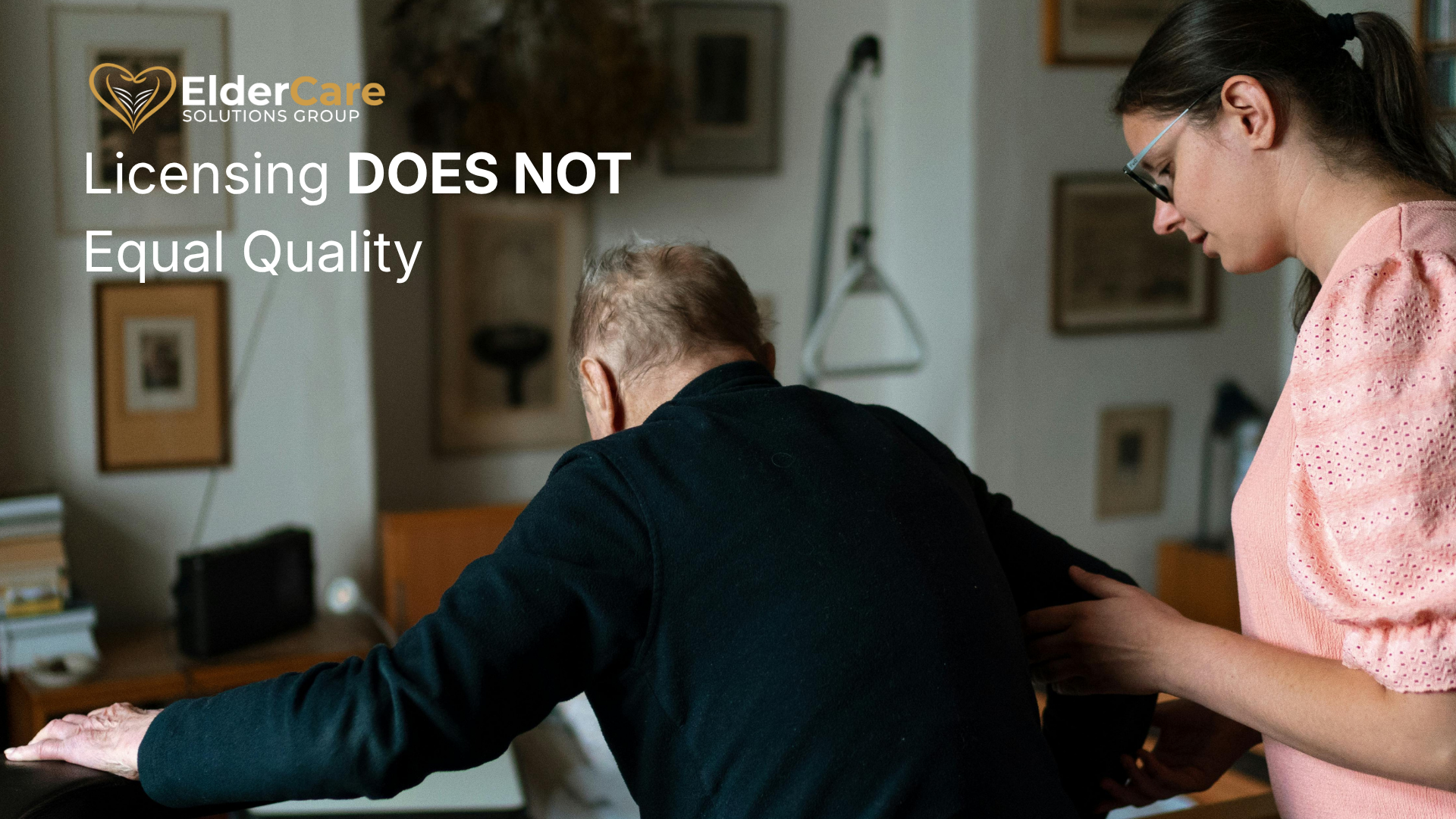
Licensing equals compliance. It does not imply or guarantee quality.
Tie this to the statistics of how elder care homes are failing to meet quality standards.
The goal of this blog is to educate on the legally unlicensed, faith based, multi generational care home model designed to put people back at the center of care.
Elder Care Homes Licensing Does Not Equal Quality
When families begin searching for elder care, licensing often feels like a reliable shortcut. If a home is licensed, it must be safe. If it meets regulations, it must provide good care.

That assumption is understandable—but it’s also where many families make their first critical mistake.
Licensing matters. But it only tells you that a facility meets minimum requirements to operate. It does not tell you how care is actually delivered day to day. And that difference is where outcomes are decided.
Why Licensing Feels Like a Reliable Signal
THE ROLE LICENSING PLAYS IN DECISION-MAKING
Licensing creates a sense of structure in an otherwise overwhelming process.
Families are often:
Under time pressure
Navigating unfamiliar systems
Trying to reduce risk quickly
So licensing becomes a filter:
“At least this place is approved.”
It feels like a baseline for safety—and something you can trust when you don’t know what else to look for.
WHY FAMILIES DEFAULT TO COMPLIANCE AS PROOF OF QUALITY
Most people assume:
Regulations are strict
Inspections are thorough
Poor care would be caught and corrected
On paper, that sounds reasonable.
But in practice, licensing is designed to confirm that a facility is not failing at a critical level—not that it is consistently delivering high-quality care.
That’s a very different standard.
What Elder Care Homes Licensing Actually Covers
MINIMUM REQUIREMENTS TO OPERATE
Licensing ensures that a facility meets basic operational criteria, such as:
Staffing minimums
Safety protocols
Facility standards
Documentation requirements
These are essential. Without them, a home shouldn’t be operating at all. But they are entry-level conditions, not indicators of excellence.
INSPECTIONS AND COMPLIANCE STANDARDS
Facilities are evaluated through periodic inspections.
These typically focus on:
Policy adherence
Recordkeeping
Safety compliance
Observable violations at the time of inspection
Here’s the key limitation:
Inspections are snapshots, not continuous evaluations.
They show how a facility performs during a controlled moment—not how it functions every day, across every shift.
What Licensing Does Not Measure
This is where the gap becomes clear.
DAY-TO-DAY CARE CONSISTENCY
Licensing does not capture:
Whether residents receive timely help when they need it
How consistently routines are followed
What care looks like during understaffed shifts
A home can pass inspection and still struggle to deliver consistent care across a full week.
STAFF ENGAGEMENT AND RESPONSIVENESS
You won’t find this in a compliance report:
How quickly staff respond to call lights
Whether caregivers know residents personally
How staff handle confusion, anxiety, or resistance
These are the moments that define real care—and they are largely invisible to licensing.
RESIDENT EXPERIENCE AND ENVIRONMENT
Licensing doesn’t measure:
The emotional tone of the home
Whether residents are engaged or isolated
How the environment feels during unstructured time
You can walk into two homes and feel the difference immediately.
That difference is not captured in a checklist.
Why Licensed Homes Still Deliver Poor Outcomes
STAFFING INSTABILITY AND VARIABILITY
Even in licensed facilities:
Staff turnover can be high
Shift coverage can vary
Experience levels can fluctuate
This creates inconsistency—especially during nights and weekends, when oversight is lower.
OPERATIONAL PRESSURE AND RESOURCE CONSTRAINTS
Many facilities operate under:
Tight financial margins
High occupancy pressure
Limited staffing flexibility
This affects:
Time per resident
Staff burnout
Attention to detail
The system often pushes efficiency—not individualized care.
INSPECTION PERFORMANCE VS DAILY CARE REALITY
Facilities prepare for inspections.
They:
Ensure documentation is complete
Align processes to regulatory expectations
Present operations at their best
But what happens:
On a short-staffed Sunday evening
During a chaotic shift change
When multiple residents need attention at once
That’s where real care quality shows—and where licensing has limited visibility.
The Structural Limits of the Current System
SYSTEM DESIGNED FOR A DIFFERENT CARE ENVIRONMENT
The elder care system was built around:
Shorter life expectancies
Lower rates of complex conditions
More institutional models of care
Today’s reality is different:
Longer lifespans
More dementia and chronic illness
Greater need for personalized support
The structure hasn’t fully adapted.
ECONOMIC PRESSURE SHAPING CARE DELIVERY
There’s a tension in the system:
Families struggle with affordability
Facilities struggle with profitability
That pressure influences:
Staffing levels
Time allocation
Operational decisions
Licensing cannot correct for these deeper constraints.
What Actually Signals Quality in a Care Home
If licensing doesn’t tell you what you need, here’s what actually does.
STAFF CONSISTENCY AND INTERACTION PATTERNS
Watch for:
Staff who greet residents by name
Familiarity between caregivers and residents
Calm, confident interactions—not rushed or reactive
Consistency is one of the strongest indicators of stable, reliable care.
ENVIRONMENT TONE AND RESIDENT ENGAGEMENT
Pay attention to:
Whether residents are engaged or inactive
The general noise level and energy of the space
How people are interacting—not just sitting
A well-functioning home feels:
Structured but not rigid
Calm but not quiet from disengagement
COMMUNICATION AND VISIBILITY INTO CARE
Strong homes:
Communicate clearly with families
Provide updates without being asked
Are transparent about challenges—not just successes
If information feels hard to access during a tour, it won’t improve after move-in.
How to Evaluate a Home Beyond Licensing
This is where you shift from observer to decision-maker.
WHAT TO OBSERVE DURING A VISIT
Look beyond appearances.
Focus on:
How long it takes for staff to respond to residents
Whether interactions feel personal or transactional
What’s happening in unscripted moments
Spend enough time to see past the “tour version” of the facility.
WHAT TO ASK STAFF AND CAREGIVERS
Ask questions like:
“How do you handle overnight staffing?”
“What happens when multiple residents need help at once?”
“How long have most of your staff been here?”
Listen for:
Specific, confident answers
Or vague, generalized responses
Clarity signals operational strength.
WHAT SIGNALS SHOULD RAISE CONCERN
Be cautious if you notice:
Staff avoiding direct answers
Residents left unattended for extended periods
High visible turnover or unfamiliarity
These are not small issues—they tend to reflect deeper systemic problems.
A Different Approach to Elder Care
Not all care environments are structured the same way.
SMALLER, RELATIONSHIP-BASED CARE ENVIRONMENTS
Some models prioritize:
Lower resident-to-caregiver ratios
Consistent staffing
More individualized attention
This can create:
Stronger relationships
More predictable care experiences
MULTI-GENERATIONAL AND COMMUNITY-INTEGRATED CARE
Other approaches integrate:
Family involvement
Community interaction
Shared living dynamics
These environments often feel less institutional and more relational.
HOW STRUCTURE AFFECTS DAILY CARE EXPERIENCE
The structure of a care setting directly shapes:
How time is spent
How attention is distributed
How relationships form
Understanding that structure helps you evaluate whether it aligns with what your loved one needs.
What to Take With You Before Choosing Care
Licensing is the baseline, not the benchmark. It tells you a home meets minimum standards ... that have nothing to do with the care being provided.
It does not tell you:
How care feels
How consistent it is
How your loved one will actually experience it
What to prioritize when evaluating care
Focus on:
People → how staff interact and respond
Patterns → consistency across time and situations
Environment → engagement, tone, and visibility
These are the signals that licensing cannot give you but that matter most once care begins.
Choosing elder care is not about finding a place that passes inspection.
It’s about finding a place that holds up under real, everyday conditions—when no one is watching, and it matters most.
ElderCare Solutions Group focuses on supporting more relationship-centered approaches to care—helping families and providers create environments that prioritize dignity, connection, and real daily life.